This website is for healthcare professionals - NIOX PRO® is available in the following countries.

FeNO Testing

What’s in the air matters: Ambient NO and FeNO testing

Ambient nitric oxide (NO) naturally exists in the air, and can pose a real risk for FeNO testing results validity when not properly removed before testing.1-6 In this article we will look at the potential impact of ambient NO, what the guidelines say, and how this risk can be effectively managed with NIOX® Technology.

Last updated: September 2026

Share this article: - - -

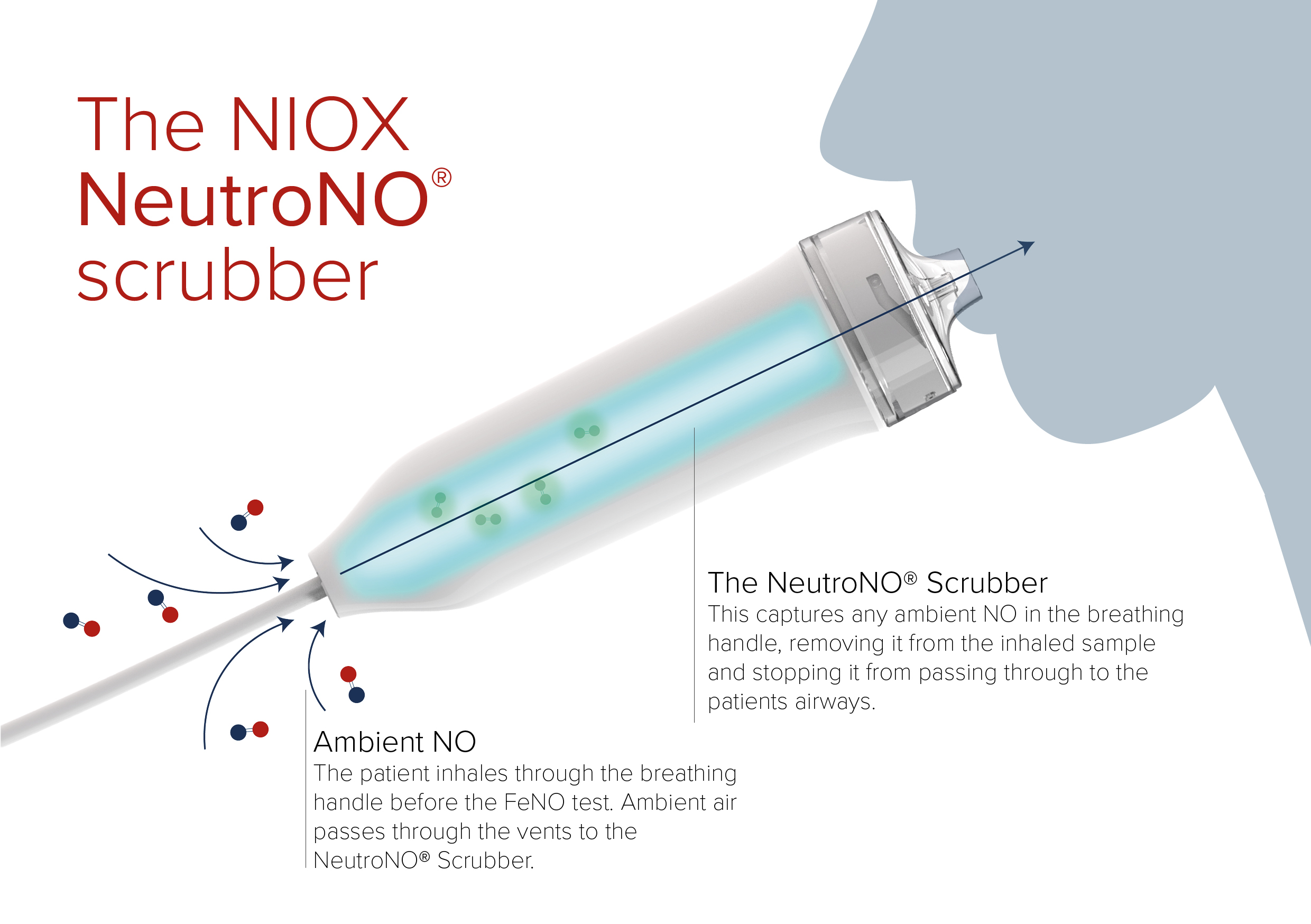
NIOX NeutroNO® technology helps ensure FeNO measurements remain free from environmental NO contamination.

What is ambient NO?

Ambient nitric oxide is an odourless gas, commonly present in the air we breathe. It is regarded as a pollutant, originating from sources such as vehicle emissions, industrial activity, gas stoves, and even wildfires. This can accumulate in poorly ventilated spaces and is common in higher levels in urban areas.

It can exist in 2 – 500 ppb, and while invisible, it can significantly skew FeNO results when not properly removed, posing a serious risk to FeNO test validity when inhaled during measurement. 1-6


How does ambient NO affect FeNO results?

Early studies identified ambient nitric oxide as a potential source of variability in exhaled NO measurements, concluding that ambient NO increases measured FeNO levels.2-4 This is one of the variables accounted for in the 2005 ATS/ERS standardised measurement procedures.7

When a patient inhales air containing elevated levels of ambient NO before or during the test, this contaminant can enter the lungs and artificially inflate the measured FeNO value.1-6 FeNO results are used to guide diagnosis and treatment initiation and adjustment, meaning an artificially elevated FeNO reading could misguide clinical decisions.7,8

Ambient NO poses a real risk to FeNO validity - research has shown that ambient NO can easily exceed the threshold that can interfere with FeNO testing, with levels of over 100 ppb measured in some clinics.3,9

ARTICLE SUMMARY

  • Ambient NO can artificially elevate FeNO readings and affect result validity.
  • ATS/ERS standards recommend controlling ambient NO before exhalation.
  • NIOX NeutroNO® technology removes ambient NO from inspired air before testing for reliable results.
What’s in the air matters: Ambient NO and FeNO testing

What do the guidelines say?

ATS/ERS recommendations for standardised procedures for FeNO testing outline the need to remove ambient NO as not to impact FeNO results.7 They specify that inspired gas should contain low NO concentration of less than 5 ppb.7 This is to ensure that the sample is not contaminated with possibly high NO from the environmental air, which may otherwise impact measurement accuracy.7,10

The ATS/ERS standards specify controlling the inhaled concentration of ambient NO - not trying to manage it during the measurement.7 Inhalation of ambient NO-free air is part of the original ATS/ERS standardisation and remains embedded in modern FeNO measurement.7 NIOX® devices fully conform to these standards.11


How do NIOX® devices deal with ambient NO?

While it may be difficult to control environmental nitric oxide concentrations, NIOX® devices remove ambient NO from the inhaled air before testing.

All NIOX® devices contain an integrated NIOX NeutroNO® scrubber in the breathing handle and require patients to inhale through the breathing handle before exhaling for the test. Inhalation through the handle ensures that ambient nitric oxide is removed from the inspired air - ensuring that only ambient-NO free air is inhaled and measured.5 This initial 4-5 second inhalation is a quick, easy but essential step to remove the influence of ambient NO.

Studies have shown that inhalation through a scrubber has been shown to be up to 100% effective in dealing with variable levels of ambient NO.5,9 Relying on removing dead-space air to control ambient NO levels may remove the initial peak, but this does not control against the impact of ambient NO.2,7

The unique NIOX NeutroNO® technology means that the FeNO result produced is truly reflective of the patient’s airways – not influenced by environmental NO.5,9 This ensures results remain reliable and consistent, no matter where you are.5,9,12

What’s in the air matters: Ambient NO and FeNO testing

Ambient NO is often an overlooked factor in FeNO testing, but its impact on result validity can be significant.2-6 Because FeNO measurements are used to support important clinical decisions, artificially elevated readings caused by environmental NO have the potential to misguide diagnosis and treatment decisions.7,13

We know nitric oxide is a small but powerful molecule, that’s exactly why FeNO testing is such a valuable tool in airway inflammation assessment.13 But it is equally important to ensure that the FeNO technology being used measures NO from the patient’s airways, not the surrounding environment.7

With integrated NIOX NeutroNO® scrubber technology, NIOX® devices remove ambient NO from inspired air before testing, helping ensure accurate and reliable FeNO results every time.5,9,12,14

Trusted by healthcare professionals worldwide, NIOX® technology continues to set the standard in FeNO testing.11 Learn more on our NIOX® Technology page or book a demo to see it in action.

Discover FeNO Testing

Learn about FeNO with our free app

Why NIOX®

Explore the Gold Standard device*

Understand FeNO Scores

Use our interpreting FeNO calculator

* NIOX®. Data on File; MKT-DOF-007. 2024.

NIOX® Customer Support and Training

At NIOX® we are passionate about providing excellent support and training.

References:

  1. Clapp L et al. Analysis of the relationship between ambient levels of O3, NO2 and NO as a function of NOx in the UK. Atmos Environ. 2001;35(36):6391-6405
  2. Corradi M, et al. Influence of atmospheric nitric oxide concentration on the measurement of nitric oxide in exhaled air. Thorax 1998;53:673–676
  3. Ogoshi T, et al. influence of ambient nitric oxide (no) on the exhaled no test. 2000; 39(4);359-364
  4. Therminarias A, et al. Air Contamination with Nitric Oxide Effect on Exhaled Nitric Oxide Response. AM J RESPIR CRIT CARE MED 1998;157:791–795
  5. Linn W, et al. Relationships of online exhaled, offline exhaled, and ambient nitric oxide in an epidemiologic survey of schoolchildren. J Expo Sci Environ Epidemiol 2009;19;674–681
  6. Linn W, et al - Exhaled nitric oxide in a population-based study of Southern California Schoolchildren. Respir Res. 2009 Apr 21;10(1):28.
  7. American Thoracic Society; European Respiratory Society. ATS/ERS recommendations for standardized procedures for the online and offline measurement of exhaled lower respiratory nitric oxide and nasal nitric oxide, 2005. Am J Respir Crit Care Med. 2005;171(8):912-30.
  8. Ali H et al. The Potential of Fractional Exhaled Nitric Oxide as a Biomarker in Predicting and Optimizing Use of Treatment in Asthma. South East European Journal of Immunology. 2023;6(1):18-23.
  9. Gehring U, et al. The impact of ambient NO on online measurements of exhaled and nasal NO: the PIAMA study. Pediatr Allergy Immunol. 2009 Nov;20(7):665-72.
  10. Heffler E et al. Fractional Exhaled Nitric Oxide (FENO) in the management of asthma: a position paper of the Italian Respiratory Society (SIP/IRS) and Italian Society of Allergy, Asthma and Clinical Immunology (SIAAIC). Multidiscip Respir Med. 2020 Feb 19;15(1):36
  11. NIOX®. Data on File. MKT-DOF-007. 2026
  12. Crater G et al. Successful fractional exhaled nitric oxide measurements with NIOX VERO using 6-and 10-s exhalation modes in children with asthma aged 4–10 years: a randomized study. Pulm Ther. 2017;3:139-48.
  13. Ali H et al. The Potential of Fractional Exhaled Nitric Oxide as a Biomarker in Predicting and Optimizing Use of Treatment in Asthma. South East European Journal of Immunology. 2023;6(1):18-23.
  14. Carroll WD. NIOX VERO: Individualized Asthma Management in Clinical Practice. Pulmonary Therapy. 2016;2:171-88.

© Copyright NIOX Group plc. MKT-PRM-WW-0704. 2026.